
How to Use Synthetic Personas in UX Research Without Losing Sight of Real People

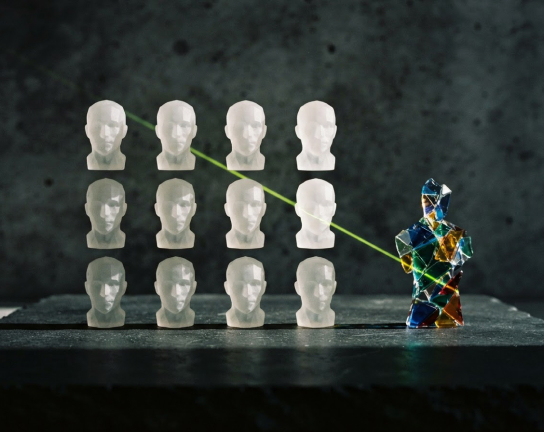
How to use synthetic personas in UX research without leaving human diversity behind? AI can arrive at a convincing conclusion and still miss the very people we most needed to hear from.
Generative models now make it possible to create fictional respondents, explore scenarios and discuss product decisions in minutes. But a simulated statement is not an interview; reproducing a common answer does not, by itself, reveal who has been left out.
Getting the Answer Right Does Not Mean Representing People
In October 2026, Nielsen Norman Group published a particularly revealing experiment. The team compared answers from 604 real technology and design professionals with those of 120 synthetic respondents, asking which label best described the work we now associate with UX.
The broad conclusion was similar: UX remained the dominant term. But that similarity faded when the researchers examined the distribution of responses. Around 84% of synthetic respondents used UX-related terms, compared with roughly 70% of humans. The synthetic group produced only about a dozen distinct labels; real people used more than 50.
The study has important limitations: the groups differed in professional composition, and the AI platform sometimes reworded the question. It is therefore not a universal estimate of accuracy. The more interesting finding is that a seemingly correct aggregate result can conceal an enormous loss of variation.

The Problem Is Not Just Bias. It Is the Missing Exceptions.
In statistics, the mode is the most frequent value. When a model repeatedly produces the most common answers rather than reflecting the full distribution of possibilities, the result can resemble mode collapse. The consensus looks strong, but the long tail of responses disappears.
That matters in product design. Someone who abandons registration because a term is unclear, a salesperson who depends on an uncommon workflow, or someone who has lost trust in the product rarely fits a description of the average user. These experiences may be exactly what exposes the most important UX failures.
Asking AI to be more creative does not, by itself, solve the problem. Generating twelve different opinions does not prove that those opinions exist in the real population, or that they occur at the right frequency. Simulated diversity is a way to explore possibilities; representativeness requires evidence.

How I Used 12 Synthetic Personas at Turn2C
At Turn2C, a Brazilian platform for consórcio products (a group-based purchasing model), I explored how to use synthetic personas in UX research as a support tool for product analysis. I structured a panel of twelve perspectives around commercial maturity, product familiarity, expectations and pain points, without treating simulated responses as evidence from real users.
I was not trying to create twelve substitutes for interviews. The aim was to avoid accepting an idea simply because it worked for the user profile our team knew best. Simulations became a discussion tool, helping us anticipate questions and formulate hypotheses to investigate with real people and behavioural data.
I organised the panel into three maturity groups. Their names describe useful perspectives—not statistically validated segments or a sample of the user base.
For the operational context behind those hypotheses, see my Turn2C onboarding and activation case study.

Figure 03 transcript: personas and outcomes
Beginners
- Uninformed
- Guidance to get started
- Curious
- Find value quickly
- Commission-focused
- Understand earnings
- Pragmatic
- Follow clear steps
Hybrids
- Integrator
- Connect existing tools
- Opportunistic
- Act on opportunities
- Solution builder
- Adapt proposals
- Disengaged
- Rebuild trust
Advanced
- Scaler
- Scale with automation
- Strategist
- Compare scenarios
- Technical
- Understand rules and calculations
- Frustrated
- Demand reliability
What did they help with?
- Broaden perspectives: Look beyond familiar users
- Anticipate friction: Identify potential drop-offs
- Assess impact: Explore effects of decisions
- Surface conflicts: Compare competing needs
- Guide research: Create testable hypotheses
Each icon represents a need — not a real person.
The Question Itself Changed
The greatest value of this exercise came from replacing a generic question—“Is this good for the user?”—with a more demanding one: “Who benefits, who is indifferent, and for whom might this become an obstacle?”
A shorter journey could help the Pragmatic Beginner run their first simulation while removing controls that the Technical Advanced persona considers essential. Commission-focused messaging might attract a Commission-Sensitive Beginner without rebuilding trust among people who have experienced recurring problems. CRM integration might be crucial to a Hybrid Integrator but irrelevant to someone who sells only occasionally.
These are examples of tensions the panel helped us examine, not findings from tests with real participants. They helped us formulate research questions and hypotheses about activation, conversion, feature adoption, time to first simulation and support needs—without confusing a simulated reaction with an observed metric.

What Other Research Adds
Research from Stanford offers a more promising possibility: agents built from in-depth interviews with 1,052 real people. On a specific battery of questions, the agents reproduced responses at 85% of the consistency participants showed when answering again two weeks later. That is not 85% general accuracy: it is a relative measure tied to that research context.
Meanwhile, a 2026 study covering twelve first-click tests and 3,431 human observations found significantly different AI and human response distributions in 53% of the tasks. Another study, published in the 2026 ACM Web Conference proceedings, found that adding persona attributes to prompts did not consistently improve alignment with human survey responses and increased distortions in some subgroups.
The lesson is not that every use of AI in research is pointless. Fidelity depends on the method, the task, the evidence used to create agents and external validation. A plausible text response is not proof of behaviour.
These questions also connect with my article on design and AI trends for 2027, particularly the role of human judgement in increasingly generative systems.

My Criteria for Using Synthetic Personas Responsibly
When deciding how to use synthetic personas in UX research, I start with the signals already available: previous studies, journey analytics, support interactions, recurring pain points and domain knowledge. Where personal data is involved, privacy, purpose and consent must be part of the method.
Next, I state explicitly what each persona represents as a hypothesis, without inventing the proportion of the user base it supposedly represents. I use AI to prompt disagreement, explore edge cases and surface questions we have not yet asked—never to fabricate participant quotes and present them as evidence.
I then document the questions, compare the hypotheses with analytics, support data, qualitative research and usability tests, and record what was supported, challenged or remains unknown. High-impact decisions require validation with real people.
My rule is simple: simulation should improve the questions we ask and the decisions about what to investigate. When it starts closing down the discussion, it becomes a risky shortcut.
Research and documentation also need to stay close to real work. In my Smarters Design System case study, I explain how different levels of familiarity and team needs helped shape research, shared patterns and governance.

The Future of Research Should Not Have Fewer People
Turn2C's twelve synthetic personas expanded the range of questions I could bring into product discussions. But none of them felt frustrated by an interface, improvised a workaround during a working day or had anything meaningful at stake when a task failed.
AI can remind us to ask about the people who were left out. Whether those people exist, what they need and how they behave must still be answered by the people themselves.
Ultimately, how to use synthetic personas in UX research is a methodological choice. I do not want AI to replace the voices of research participants. I want it to help me enter real conversations with better questions.
< FIG. 07 > LISTEN TO REAL PEOPLE
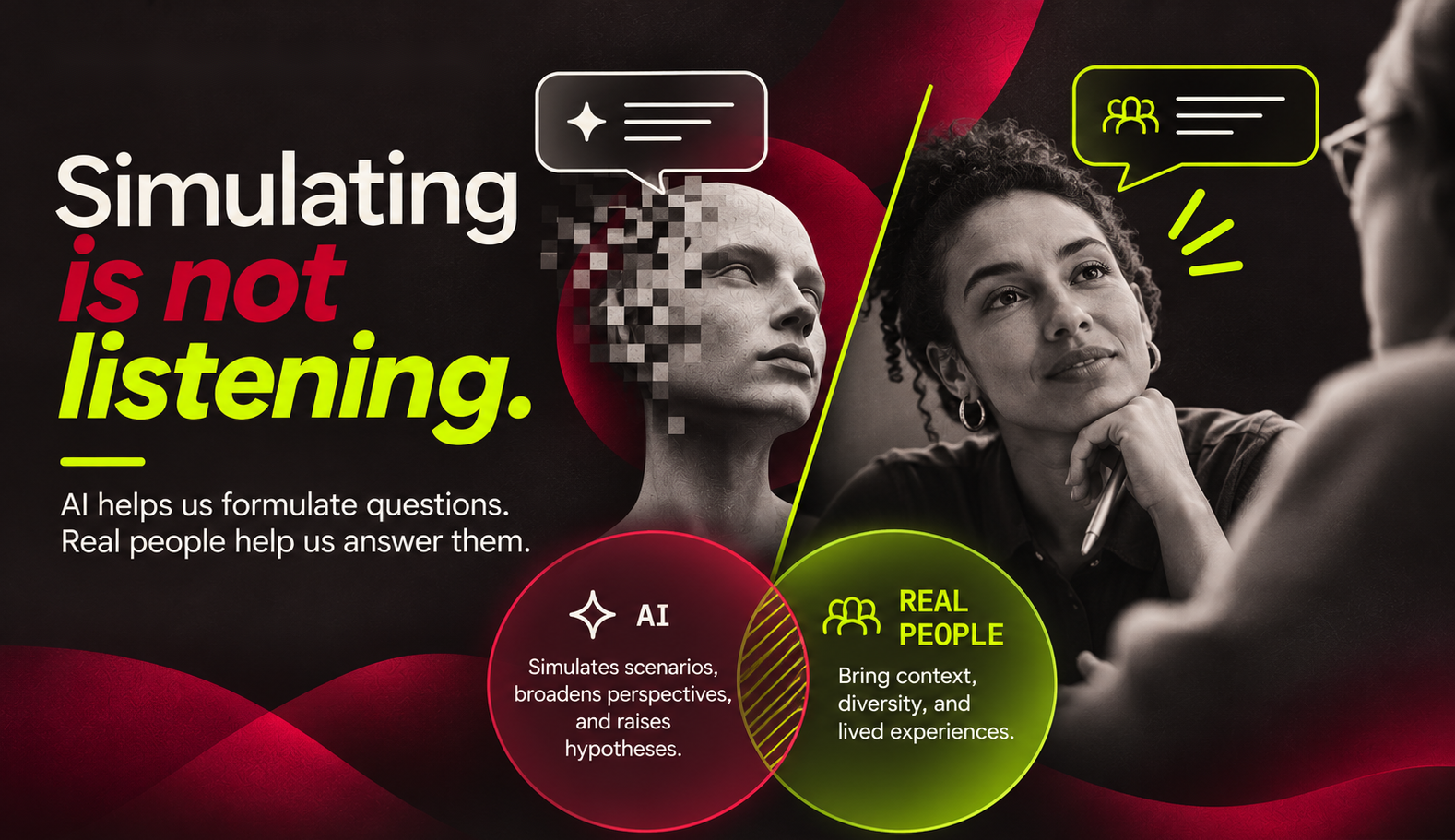
Conceptual references: NN/g (2026) and the Turn2C experience (2026).
Sources and reading notes
[1] Nielsen Norman Group (2026) — Synthetic Users vs. Human Respondents. https://www.nngroup.com/articles/synthetic-users-vs-human-respondents/
[2] Nielsen Norman Group (2024) — Synthetic Users: If, When, and How to Use AI-Generated Research. https://www.nngroup.com/articles/synthetic-users/
[3] Stanford HAI (2025) — Simulating Human Behavior with AI Agents. https://hai.stanford.edu/policy/simulating-human-behavior-with-ai-agents
[4] Kuric et al. (2026, preprint) — What Would GPT Click? https://arxiv.org/abs/2605.18302
[5] Morocho et al. (2026, ACM Web Conference Companion) — Assessing the Reliability of Persona-Conditioned LLMs. https://arxiv.org/abs/2602.18462
Individual image credits and sources appear with each figure. Generated illustrations are conceptual, not evidence from research participants.